
★★★★★
“Wonderful health care center. Friendly and really interested in helping you with your health needs.”
Corinne Collins

Ozone therapy
Intravenous ozone therapy — also called ozonated autohemotherapy, Major Autohemotherapy, or MAH — is best discussed carefully. At Simply Health Integrated Medical, it is framed as an adjunctive wellness option for selected patients — not a cure, not a disease treatment, and not a standalone answer.
What to expect
Simply Health Integrated Medical helps patients understand symptoms, goals, and options before recommending a care path.
The next step is a consultation request or direct call so the team can determine whether the clinic is a good fit for your needs.
Simply Health Integrated Medical is in Creve Coeur, at 12977 N Forty Dr, Suite 105, where I-64 meets I-270, a short drive from Town and Country, Chesterfield, and the rest of west county. The IV ozone procedure discussed here is ozonated autohemotherapy: a measured amount of your own blood is drawn, mixed with an oxygen-ozone gas mixture outside the body, and returned intravenously. Ozone gas is not injected into a vein; that is a different procedure, and one published protocols say must not be used.
No one is scheduled for a session first. The clinic's medical team screens for the conditions that rule this procedure out, reviews your medications, and walks through what the evidence does and does not support. Some people are told no; that answer is part of the service. If you are weighing options across the St. Louis area, the next step is a consultation, by the form below or by calling (636) 590-4686.
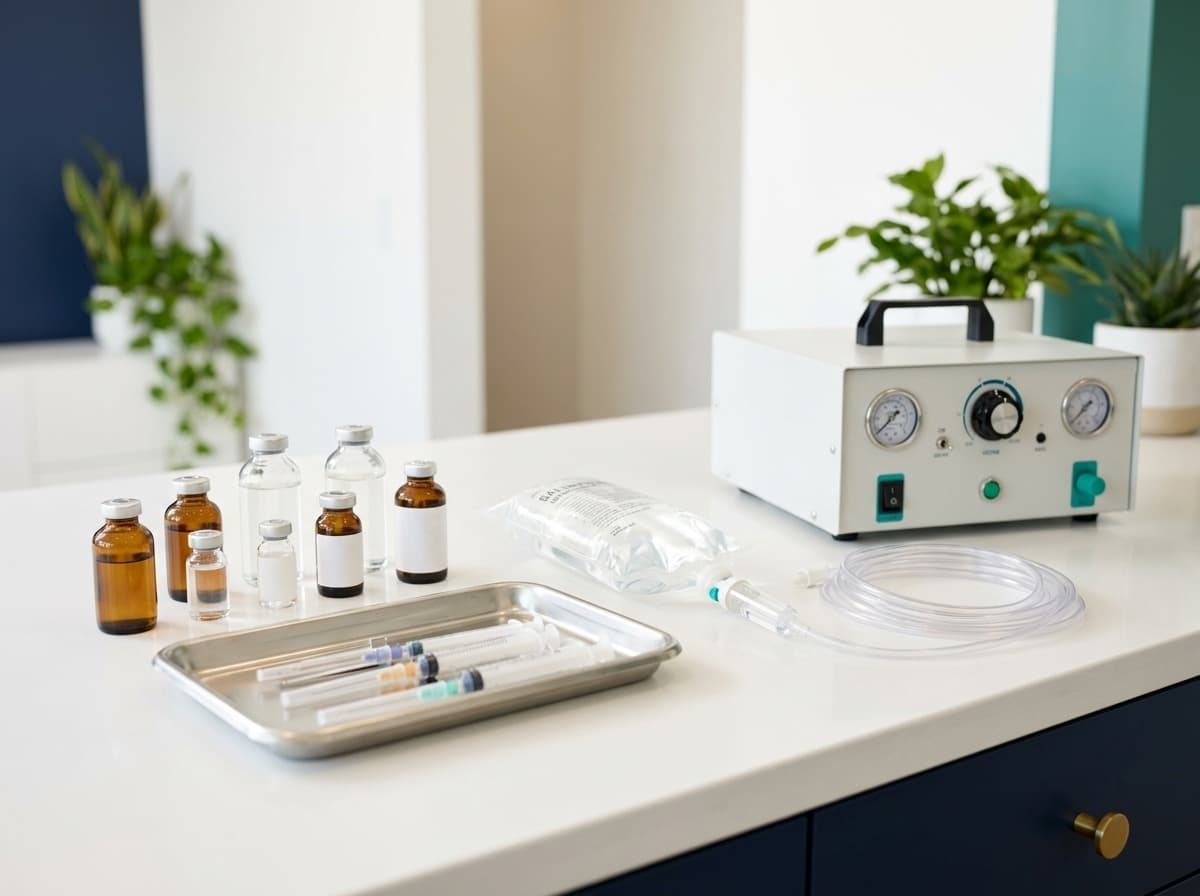
Major Autohemotherapy typically involves drawing a measured amount of blood, combining it with medical-grade ozone using appropriate equipment, and reintroducing it intravenously. The Major Autohemotherapy procedure published by the International Scientific Committee of Ozone Therapy (ISCO3) draws roughly 50 to 100 mL of blood into an ozone-resistant container with an anticoagulant (citrate), adds a measured volume of oxygen-ozone gas, mixes it gently, and reinfuses it over about 20 to 30 minutes. The same protocol caps the ozone concentration at 78 micrograms per milliliter because higher concentrations risk hemolysis (rupture of red blood cells), and says the reinfusion should never be hurried.
Those ranges come from the society's protocol and say nothing about how any one clinic runs the procedure, so ask what protocol, equipment, anticoagulant, and concentration will be used in your case.
What MAH is not: pushing ozone gas straight into a vein from a syringe. The ISCO3 protocol says that technique must not be used, naming infection, clotting, gas embolism, and vein damage as the reasons. Because even the closed-system procedure is invasive, patients deserve clear explanation of purpose, technique, risks, alternatives, and fit before deciding whether to proceed.
Patients researching this topic run into several names for the same procedure: ozonated autohemotherapy, Major Autohemotherapy, MAH, ozone blood therapy, and IV ozone therapy all generally describe the process above — blood is drawn, mixed with medical-grade ozone, and returned intravenously. The vocabulary varies between clinics and articles, but the screening questions do not: who is performing it, what equipment and protocols are used, what risks and alternatives exist, and whether a given person is an appropriate candidate. Whatever name you searched for, those are the questions worth asking first.
One caution: online, "IV ozone therapy" sometimes also covers direct injection of ozone gas into a vein, the route described above as off-limits, and some consumer references grade all ozone "given by IV" as unsafe without separating the two. That is one more reason the route question belongs at the top of your list.
Patients often ask where ozone fits within functional medicine, recovery, wellness, immune-support discussions, or broader integrative care. The conversation should stay grounded: what is the goal, what does the evidence say, what are the risks, and is there a more appropriate first step?
Is IV ozone therapy safe? It carries real risks, the evidence for benefit is limited, and the U.S. regulator has not endorsed it.
**What the FDA says.** The FDA's position is written into a device regulation, 21 CFR 801.415, which states: "Ozone is a toxic gas with no known useful medical application in specific, adjunctive, or preventive therapy." The rule governs ozone-generating devices and their labeling. The FDA has not authorized ozone therapy for any condition.
**What the evidence says.** Cleveland Clinic describes the evidence for benefit as "low-quality and limited" and notes that ozone therapy has not been tested in large-scale clinical trials. Small studies exist, including uncontrolled and laboratory work, and they do not establish that the procedure treats anything. A published protocol from a professional ozone society describes a technique; it is not proof the technique works.
**What can go wrong.** The serious risk is gas embolism: gas entering the bloodstream and blocking a vessel, which can cause a stroke or heart attack. Autohemotherapy is designed to avoid injecting gas into a vein, and that reduces the risk. It does not remove it. Serious harm, including embolic strokes, has been reported after IV ozone sessions. A 2025 case report describes a previously healthy 36-year-old who had chest pain, fainting, and a seizure minutes after a session in which her own ozonated blood was returned to her; imaging showed multiple small strokes, and cognitive deficits persisted nine months later. One case cannot say how often that happens. It does show the closed-system design is not a guarantee. High ozone concentrations can also rupture red cells (hemolysis), the reason for the concentration cap above.
**Milder effects.** Clinic guides for this route report effects that some patients notice: headache, fatigue, dizziness, nausea, and bruising or vein irritation at the draw site.
Ozone therapy should not be positioned as a cure for disease or a replacement for appropriate medical care. Candidate screening, sterile technique, medical-grade equipment, medication review, and realistic expectations matter. Some patients should not pursue this option, and the next section names them.
The ISCO3 procedure lists G6PD deficiency, an inherited red-blood-cell enzyme deficiency, as an absolute contraindication and recommends testing for it before therapy. Its list of conditions that rule the procedure out or call for special caution includes:
- pregnancy, especially the first three months - uncontrolled hyperthyroidism (overactive thyroid) - low platelet counts or serious clotting disorders - unstable cardiovascular disease or a recent heart attack - hemochromatosis (iron overload), or current iron or copper therapy - uncompensated diabetes - seizure disorders - heavy active bleeding or acute alcohol intoxication
Clinic guides that describe this route add anemia, active bleeding disorders, severe asthma or COPD, and breastfeeding.
Screening here starts with your history and a medication review; ask whether G6PD testing is part of yours. If any of the conditions above apply, expect to be told no, or pointed to a different first step, often a functional medicine evaluation that looks at what is driving your symptoms before any adjunctive option is on the table.
When appropriate, ozone therapy may be considered alongside functional medicine, IV nutrient support, nutrition, hormone evaluation, or other wellness strategies. It should be one part of an individualized plan, not the entire plan.
If you are considering intravenous ozone therapy, request a consultation first. The goal is to understand whether MAH is reasonable for your wellness goals, what alternatives exist, and whether another evaluation should come first. Simply Health Integrated Medical is at 12977 N Forty Dr, Suite 105, St. Louis, MO 63141; call (636) 590-4686.


Research & clinical context
These outside resources are included for education and credibility. They do not replace individualized medical advice, but they help explain why evaluation, fit, safety, and realistic expectations matter.
PubMed / Frontiers in Public Health
Evidence-map context showing why ozone therapy should be presented cautiously and within individualized care planning.
View source →
Electronic Code of Federal Regulations
Regulatory safety context for ozone, reinforcing the need for conservative language and careful clinical screening.
View source →
Testimonials
A mix of patient testimonials to show a broader range of care experiences.
★★★★★
“Wonderful health care center. Friendly and really interested in helping you with your health needs.”
Corinne Collins
★★★★★
“Before coming to Simply Health, my pain was a 12 out of 10! I was in tears even walking into the office. I was afraid to get surgery at my age, and I really didn’t know if I would ever be able to do the things I used to. After my first treatment, my pain went to a 2! Now I have zero pain! Thank you so much! You’re a prayer answered!”
Janet F
Frequently asked
Simply Health Integrated Medical offers IV ozone therapy (Major Autohemotherapy) consultations at 12977 N Forty Dr, Suite 105, St. Louis, MO 63141 — at the I-64/I-270 interchange in Creve Coeur. It is offered as an adjunctive wellness option after individualized screening. Call (636) 590-4686.
IV ozone therapy, or Major Autohemotherapy (MAH), typically involves drawing a measured amount of blood, combining it with medical-grade ozone outside the body, and reintroducing it intravenously. Ozone gas itself is not injected into a vein. It is an adjunctive wellness option — not a cure or a disease treatment — and candidacy is screened first.
Ozonated autohemotherapy, Major Autohemotherapy (MAH), and ozone blood therapy are different names for the same general procedure: blood is drawn, combined with medical-grade ozone, and returned intravenously. "IV ozone therapy" usually means the same thing, but online it is sometimes used for direct injection of ozone gas into a vein, a different procedure that published protocols say must not be used. Whichever term you searched, candidacy and screening come first.
Not without qualification. The FDA's device regulation calls ozone a toxic gas with no known useful medical application, the evidence for benefit is limited, and embolic strokes have been reported after IV ozone sessions. Autohemotherapy is designed to avoid injecting gas into a vein, which reduces that risk without removing it. It should never replace appropriate medical care.
After screening, a measured amount of blood is drawn into a sterile, ozone-resistant container, mixed with a set volume of oxygen-ozone gas, and reinfused through an IV. Published protocols describe roughly 50 to 100 mL of blood and a reinfusion of about 20 to 30 minutes. Ask what protocol and settings will be used for you.
Milder effects some patients report include headache, fatigue, dizziness, nausea, and bruising or vein irritation where the blood was drawn. Serious risks include gas embolism, which can cause a stroke, and hemolysis at high ozone concentrations. Treat any chest pain, fainting, weakness, vision change, or confusion during or after a session as an emergency.
Cost depends on whether a single session or a series is appropriate and how IV ozone fits a broader wellness plan, which is reviewed during the consultation. Call (636) 590-4686 or request a consultation for current pricing and candidacy.
Next step
A consultation helps the team understand your goals, health history, and whether this service belongs in your care plan. The goal is fit, clarity, and a practical recommendation — not a generic protocol.